
Books
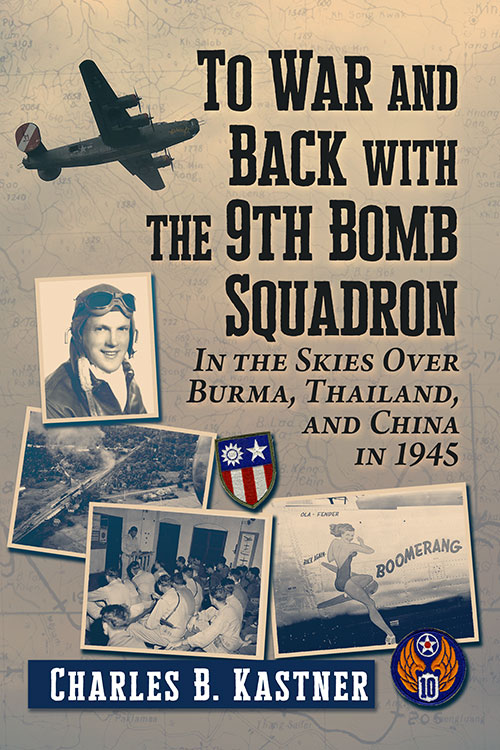
To War and Back with the 9th Bomb Squadron
In the Skies Over Burma, Thailand, and China in 1945
To War and Back follows my father, Lt. Walt Kastner, from the start of World War Two until its end. He joined a new B-24 bomber crew as a navigator that fought with the 9th Bomb Squadron from its base in India during the drive to liberate Burma from the Japanese Army. To this end, his air crew attacked Japanese troop concentrations that barred the advance of the British 14th Army, and flew missions deep into Thailand, including attacking the Burma-Siam Railway, the crucial rail link that carried supplies that fed and equipped the Japanese Army in Burma—a railway made famous by the movie, The Bridge on the River Kwai. When air combat ended in May 1945, the squadron moved to Assam in eastern India, where they hauled aviation gasoline over the Himalayas to 14th Air Force in China. Flying “the Hump” exposed them to the most dangerous flying conditions in the world. They flew the Hump until they were sent home in October 1945.
Available for Pre-Order






Syracuse University Press
Syracuse, New York 13244-5290
Order from Syracuse University Press
Order from Barnes & Noble
Order from Amazon
Race Across America
Eddie gardner and the Great Bunion Derbies
In two epic footraces across America in 1928 and 1929, an African American runner, Eddie “The Sheik” Gardner withstood daily death threats and intimidation to compete at the highest levels of the new sports of trans-America racing, and became a symbol hope and pride to Black America for his courage.
From the Book
“On April 23, 1929, the bunion derby returned to the Jim Crow South. On that day, Eddie “the Sheik” Gardner, an African American runner from Seattle, Washington, was leading the bunion derby across the Free Bridge over the Mississippi River that separated Illinois from Missouri. He was flying, blazing over the short, by derby standards, twenty-two-mile course at a sub-three-hour marathon pace. Eddie was wearing the distinctive outfit that earned him his nickname, a white towel tied around his head and a white sleeveless shirt and white shorts, but he had added something new to his outfit. Below his racing number, “165,” he had sewn an American flag, a reminder to all who saw him run that he was an American and, that day, the leader of the greatest footrace in the world. He was setting himself up for another collision with southern segregation.”
Syracuse University Press
Syracuse, New York 13244-5290
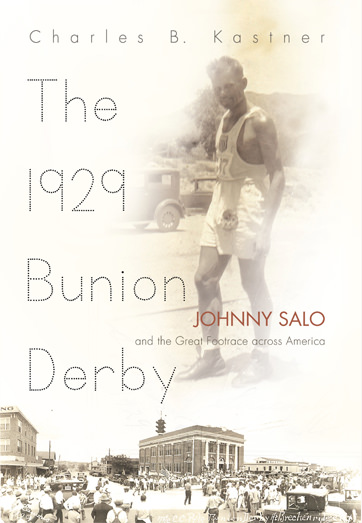
The 1929 Bunion Derby
Johnny Salo and the Great Footrace across America
On March 31, 1929, seventy-seven men began an epic 3,554-mile footrace across America that pushed their bodies to the breaking point. The race was nicknamed the “Bunion Derby” by the press. The men averaged forty-six, gut-busting miles a day during seventy-eight days of non-stop racing that took them from New York City to Los Angeles.
This was the second and last of two trans-America footraces held in the late 1920’s. Forty-three of the racers were veterans from the first ever trans-America race held in 1928. These veterans had learned hard-won lessons of pace, diet, and training, and they put them to good use the next year. Among this group, two brilliant runners, Johnny Salo of Passaic, New Jersey and Pete Gavuzzi of England, emerged to battle for the $25,000 first prize along the mostly unpaved roads of 1929 America, with each man pushing the other to go faster as the lead switched back and forth between them.
To pay the prize money, race Director Charley Pyle cobbled together a traveling vaudeville company, complete with dancing debutantes, an all-girl band wearing pilots’ outfits, and blackface comedians, all housed under the massive show tent that Charley hoped would pack in audiences.
This is the story of, arguably, the greatest footrace in the world.
University of New Mexico Press
Albuquerque, New Mexico 87106
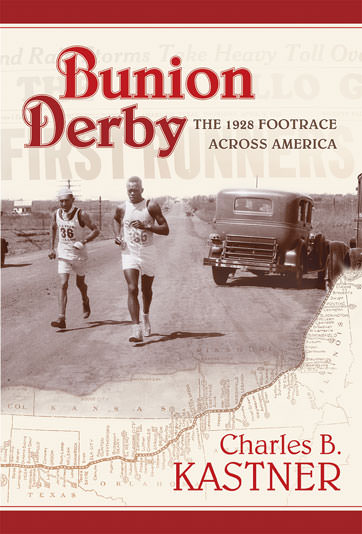
Bunion Derby
The 1928 Footrace across America
On March 4, 1928, 199 men lined up in Los Angeles, California, to participate in a 3,400-mile trans-continental footrace to New York City. The Bunion Derby, as the press dubbed the event, was the brainchild of sports promoter Charles C. Pyle. He promised a $25,000 grand prize and claimed the competition would immortalize U.S. Highway Route 66, a 2,400-mile road, mostly unpaved that subjected the runners to mountains, deserts, mud, and sandstorms, from Los Angeles to Chicago.
The runners represented all walks of life, from immigrants to millionaires, with a peppering of star international athletes who Pyle included for publicity purposes. For eighty-four days, the men competed in this part footrace and part Hollywood production that included a road show featuring football legend Red Grange, food concessions, vaudeville acts, sideshows, a portable radio station, and the world’s largest coffeepot, sponsored by Maxwell House, serving ninety gallons of coffee a day.
Drawn by hopes of a better future and dreams of fame, fortune, and glory, the bunioneers embarked on and exhaustive and grueling journey that challenged their physical and psychological endurance to the fullest while Pyle struggled to keep his cross-country road show afloat.